mazbook1, Jul 24, 2013: I have lived and cooked in México full-time now for 16 years and there is one puzzle I still haven’t solved. The spice saffron – azafrán – is probably the world’s most expensive spice, as it is just the dried stigmas of the purple flowers of the crocus sativa. Expensive since only the dried stigmas of the flowers must be harvested by hand and the yield from any one crocus plant is tiny. Sooo…
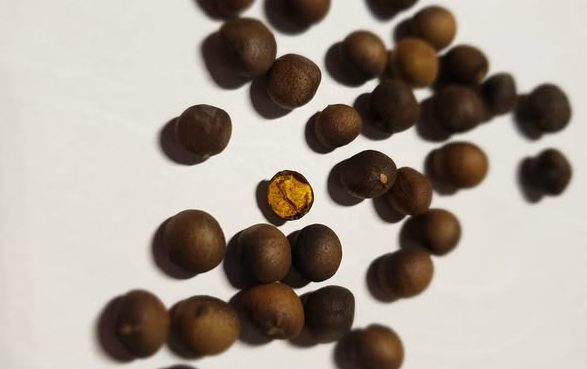
Mexican cooks most usually use some other, much cheaper substitute (for its color only since none have the flavor of true saffron). Although I finally found a reliable source of true saffron here (Sam’s Club), I have only identified two of the three common, far cheaper substitutes I have seen called and sold as azafrán here (one is what appears to be a very, very low grade of saffron or some other flower with dark red stigmas – ¿possibly the entire flower dried and crushed? – labeled as coming from China and the other is definitely ground up, dried turmeric root – cúrcuma), I haven’t been able to identify a third that is the most common “azafrán” sold here in Mazatlán. It is a small, globular, gray seed that when broken open proves to have a very thin, brittle, gray shell and a bright yellow, almost crystalline appearing, solid interior. The whole seed can be ground up and added to dishes (while cooking) where the yellow color (resembling saffron) is desired. The size of these seeds is close to what I would call small, petit pois, green peas (and yes, I know that’s redundant) rather than the larger, ordinary green dinner peas.
Try as I might to discover just what this “grey pea azafrán” is, I have completely struck out. Do any of you more savvy cooks have any idea as to just what these seeds are? Wikipedia has a picture of a small, grey dried pea called the Austrian pea but doesn’t show the interior or give any details about it (Google “types of peas” to see the photo.)
+ + + + +
GringoCarlos, Jul 25, 2013: Is this it? – Azafrán de bolita (little ball saffron) refers to the dried seeds of the Mexican plant Ditaxis heterantha. Click here for an academic paper on Ditaxis heterantha.
+ + + + +
yucatandreamer, Jul 25, 2013: Wow! Thank you. I was interested when I read the original post and now I have an answer. I had never heard of this plant or its seed. Good research.
+ + + + +
esperanza, Jul 25, 2013: Carlos, thanks so much for posting this. I’ve been wracking my brain–and wracking Google!–and hadn’t come up with anything yet. I often use cúrcuma, but have never noticed this little bolita for sale at my tianguis. I think ‘noticed’ is the operative word, because the minute I look for it, I will surely find it! The spice guy at our Tuesday neighborhood tianguis is sure to have it–he has everything else. Thanks again. https://www.mexicocooks.typepad.com
+ + + + +
mazbook1, Jul 25, 2013: Carlos, ¡muchísimas gracias! You seem to have hit on just what I never seemed to find. That is certainly what I was describing, but here in Mazatlán it is called simply “azafrán”. Maybe if I had known the rest of the Mexican Spanish name I might have found it.
Now for the dedicated cooks here on the forum, I am going to prepare two batches of saffron rice (with no other spices or flavoring), one using true azafrán and the other using azafrán de bolito just to compare the flavors, since your article says that the flavor of the azafrán de bolito is also desirable. I’ll report back on the results of this “taste test” soon.
+ + + + +

Rkit, May 26, 2016, 4:28 AM: Saffron belongs to the iris family, and has had a plethora of uses throughout millennia. As far back as the writings of Galen and Hippocrates, saffron was mentioned as a medical treatment for coughs, colds, stomach ailments, insomnia, uterine bleeding, scarlet fever, heart trouble, and flatulence.
Naturally, one of saffron’s first uses may have been for dyeing textiles, since a single grain can color 10 gallons of water with a distinctive yellow hue. More than a grain is used, however, to color the bright orange robes worn by Buddhist priests in India. Three wispy saffron “threads” can be gleaned from each delicate crocus, which, ironically, is lavender-purple in color.
As a spice, saffron is known for what it does to energize dishes with a pungent, earthy essence. It’s an ingredient used in Sweden, England, the U.S., and France, not to mention the countries where, collectively, around 50 tons are grown every year: Azerbaijan, China, Egypt, France, Greece, India, Israel, Iran, Italy, Mexico, Morocco, Spain, and Turkey. The commercial cost is about 50 million dollars, so it’s a good thing saffron can remain fresh in an airtight container for several years.
+ + + + +
citlali, May 26, 2016: Tamales de azafrán are very popular in San Cristobal de Las Casas and are made with turmeric and not azafrán . Down there turmeric is also called azafrán .
+ + + + +
esperanza, May 28, 2016: That’s true all over Mexico, as far as I know–the Spanish name for turmeric is cúrcuma, but it’s known as azafrán de raíz and used in the same way saffron is used. It gives the color but not the flavor of actual saffron.
+ + + + +
citlali, May 29, 2016: Noting equals saffron…it is so wonderful.