Alvin Starkman, M.A., J.D.
The naysayers, as well as many pundits and so-called mezcal experts, are critical of the agave distillate industry, lamenting that it is no longer sustainable. They are the same people who blanketly criticize multinational corporations and celebrities owning mezcal brands. They appear to be against big business being in the industry, and they cry cultural (mis)appropriation, with almost all of the sports and movie star owners being non-Mexican. In reality, however, traditionally made agave distillates represent an extremely sustainable Mexican industry, whose growth is fostered by both big business and celebrity incursion.
Big business and superstars
How do multinationals like the Pernod Ricards of the business world, and celebrities such as Bryan Cranston, help enhance the growth in agave distillate industry sustainability? Let’s consider the situation in the southern Mexican state of Oaxaca where most mezcal is distilled.
Two decades ago mezcal production in Oaxaca was a relatively modest industry, barely a blip on the tequila and other spirits radar. Then the explosion began, first with the sale of the Del Maguey brand to Pernod Ricard. Following suit were spirits conglomerates such as Diageo, Bacardi, and others buying brands in which they perceived profit potential. Tequila had already begun to attract celebrities, and so George Clooney, Adam Levine, The Rock, Lebron James, and others began attaching their names to the blue agave distillate. Then, finally, on the mezcal side Aaron Paul and Bryan Cranston of Breaking Bad notoriety formed Dos Hombres.
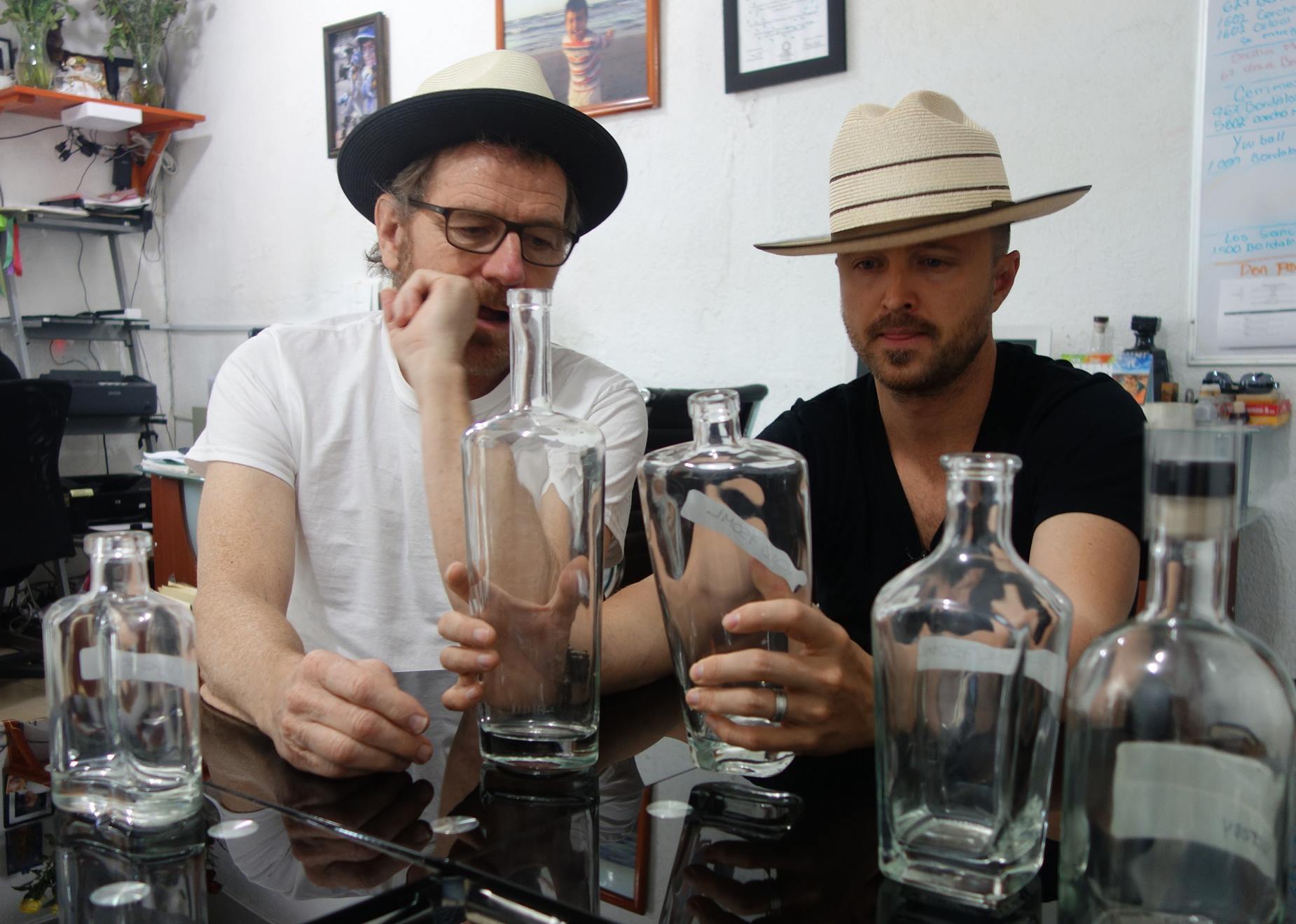
Celebrities attract regular folk who know the stars’ names but in many cases not even what mezcal is. Sales dramatically increase once fans catch wind of such spirit endorsements. Some become fans of the spirit, some don’t, and others move forward to become ardent promoters of high quality mezcal. On the other side, the corporations with the mega-bucks have a global reach, meaning sales and production skyrocket. In the state of Oaxaca alone, there has likely been a tenfold (if not greater) increase in mezcal production since the Pernod Ricard purchase. Oaxaca is the second poorest state in all Mexico, with only tourism and agriculture at its back. A dramatic increase in mezcal sales, not only in the US and Canada, but also in the UK, Australia, Belgium, France, Central and South America and elsewhere, helps grow the Oaxacan regional economy.
But many decry such a rapid increase in mezcal production, claiming Oaxaca has a lack of land, a lack of water, a lack of wild agave, and a lack of trees to convert to fuel. They point to corporate greed raping the countryside leaving the producers (palenqueros as they’re locally known), poor, as they’ve always been, if not worse off. The industry, they claim, is just NOT sustainable. However, most of those who spout negativism do not live here and fail to appreciate how the positives greatly outweigh whatever negatives there might be. They fail to see any altruism in the world, and that it can be part and parcel of capitalism. They don’t pay attention to the drastic improvement in the economic lot of palenqueros, their families, and entire villages.
Industry investors do indeed want to make a profit. But they recognize the need for a continuous supply of agave, water, and firewood for ovens and stills. There is an abundance of still-virgin land in Oaxaca for growing agave. So land is not an issue. Some claim that with more and more farmers planting agave, production of other crops will suffer. But many agricultural workers plant corn, beans, squash and garbanzo in between their rows of agave, thereby addressing the potential problem. And since agave, a succulent, takes in moisture during the rainy season to sustain itself during the dry season, if small tender agave is planted during the rainy season, no irrigation is required for the rest of the growth of the plant, be it for another 3, 5, or 15 years.
Agave, other raw materials and useful by-products
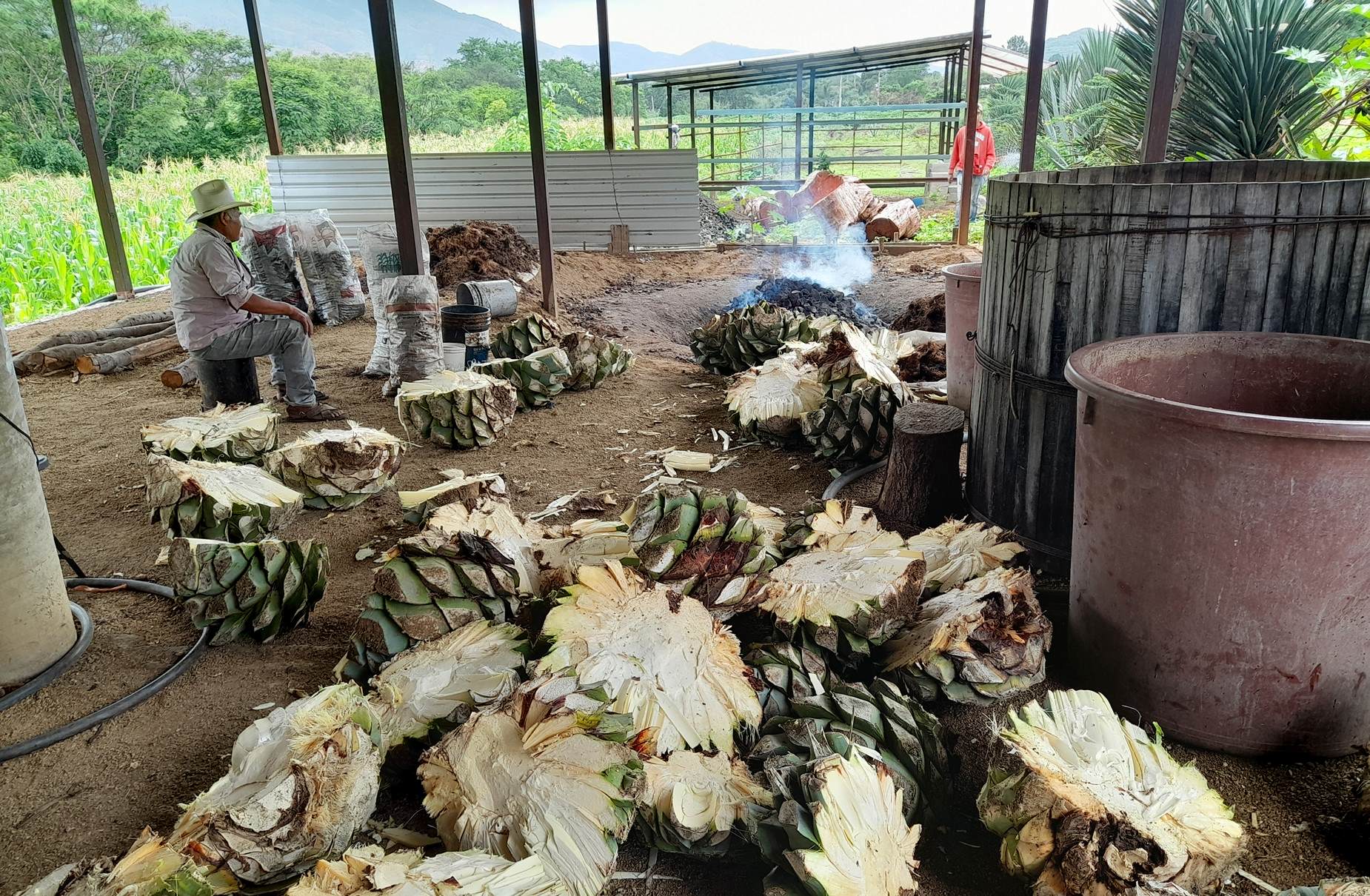
Some claim we will soon be without wild agave. True enough, palenqueros do harvest agave from the wild, but usually with permission from their communities. They, their communities, and brand owners recognize where their bread is being buttered. To ensure an ongoing supply of “wild” agave, there is an accepted business model whereby for every agave removed from the wild, two should be planted. More and more agave is being grown in greenhouses—from seed, and from harvesting baby agaves from the flower stock (maguey de quiote). They are then transplanted into the wild. Yes, there is an issue of what to call these plants when mature, since they were started and transplanted by humans before being left in the wild to grow. But that discussion is for another time. A similar issue has arisen regarding trees, because traditionally produced mezcal employs firewood as fuel for baking and distillation, resulting in stripping the forests from the hills. Reforestation projects, carried out during the rainy season, center upon planting saplings.
The wood employed to fuel the in-ground ovens need not be of high quality, unlike the straight logs used in the lumber industry. The agave distillate business can use cheaper logs, crooked or infested, as long as they are large enough. And the wood used to fuel stills can also be of any type, and even, as many palenqueros have learned, discards from the debarking process. When a lumber yard shaves all four sides of a log to remove the bark, there is virtually always some wood left on the bark. It is now often used to fuel stills, at a lesser cost to the distiller than having someone harvest wood from fields and forests.
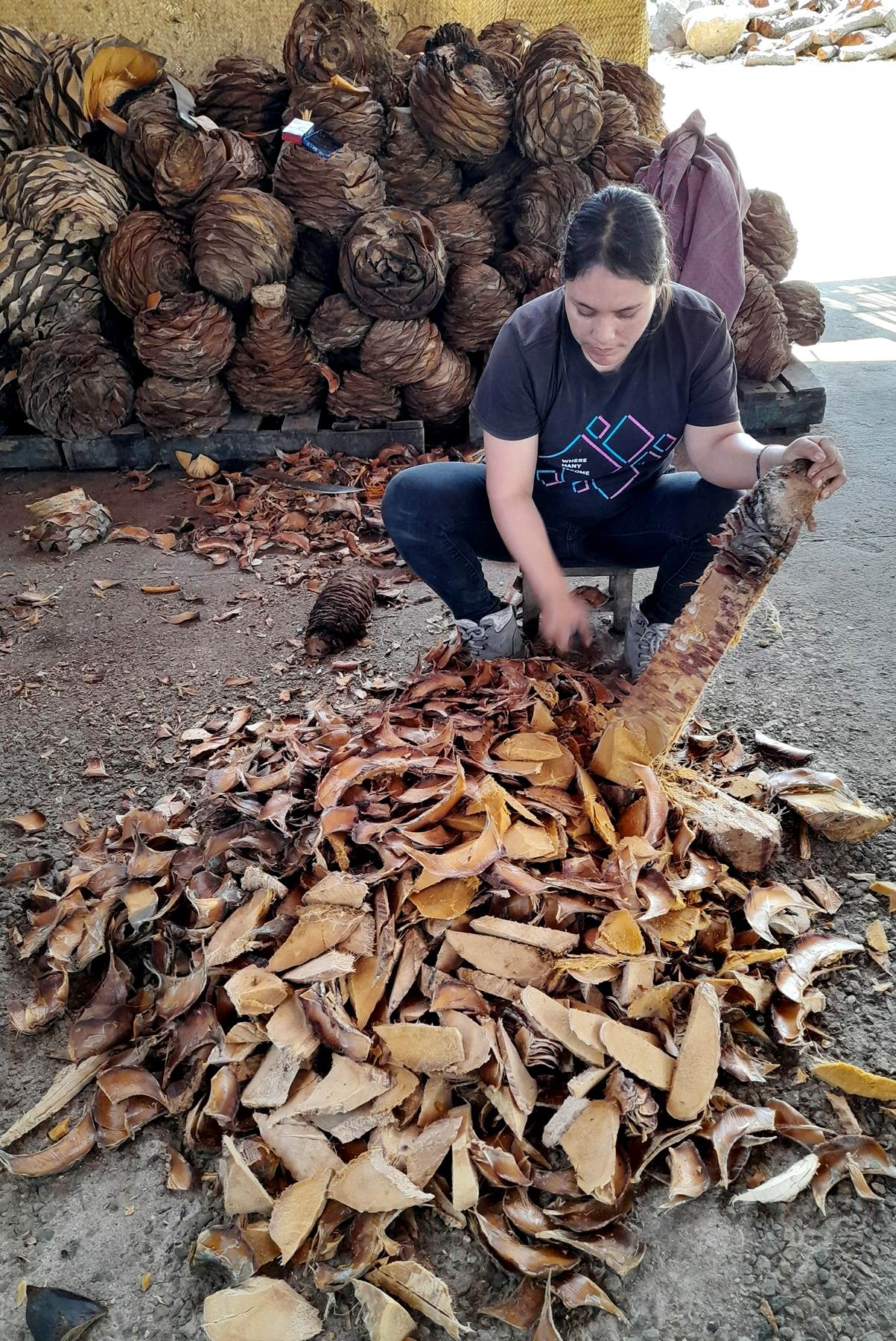
The quiote is often dried and used as firewood. Much more so in earlier times than today, several feet of it is hollowed out and transformed into a musical instrument, a didgeridoo of sorts. The flowers from the stalk can be stuffed and eaten as a delicacy. The bottom end of the stalk, still rich in carbohydrates, is ground together with corn, so as to add a bit of extra sweetness to tortillas.
The agave leaves (pencas) are not used to make mezcal. However, they are not simply waste. They are often left on the ground in the field. When partially dried and not as heavy, villagers collect them, take them home, dry them out entirely, and employ them as domestic fuel, to make tortillas, moles and salsa. They also fuel the rudimentary kilns for making pottery. The roots of the agave are not used to make mezcal—they too are often dried and used as firewood. The pencas of some species of agave, in particular Agave americana, find yet another use. A well entrenched Oaxacan tradition is to use these pencas as a flavor-enhancement when barbacoa is made. Barbacoa, a typical fare for fiestas, is made by slow cooking any type of meat, but most often goat or sheet, in a sealed in-ground oven over fire and rocks. Several Agave americana pencas can rest atop the meat, all in that enclosed chamber beneath ground level.
And finally regarding the pencas, their fiber is dried and spun into rope, grain sacks, clothing, lamp shades, and umpteen other products. During earlier times it was used as a needle and thread, their ends being as sharp as a needle. When pulled back while still attached to a strand of fiber, it becomes an instant needle and thread. Many artisans who produce brilliantly painted carved wooden figures (alebrijes) use the pointed ends of the pencas to paint tiny fine dots as part of the designs.
Efficient production methods
In terms of actual production methods, the in-ground sealed chamber (horno) usually consists of, in this order, tree trunks, rocks, waste fiber (bagazo) from the distillation process, the agave hearts (piñas), often another layer of bagazo, usually a layer of either plastic, tarp, or grain sacks which have been sewn together, or palm leaf mats (petates). Finally, dirt is piled on top to seal the oven and prevent smoke from escaping. After approximately five days cooking, the oven is emptied and is ready for another bake. At the bottom there is charcoal, since there has not been oxygen entering the oven burning the wood to ash. The wood itself can be from any type of tree although the preference is for a hard wood such as oak or mesquite. The charcoal is typically used as fertilizer to grow agave, corn or any other crop. It is also used by the palenquero’s family to cook, or sold by the grain-sack-full to anyone who needs charcoal for other purposes.
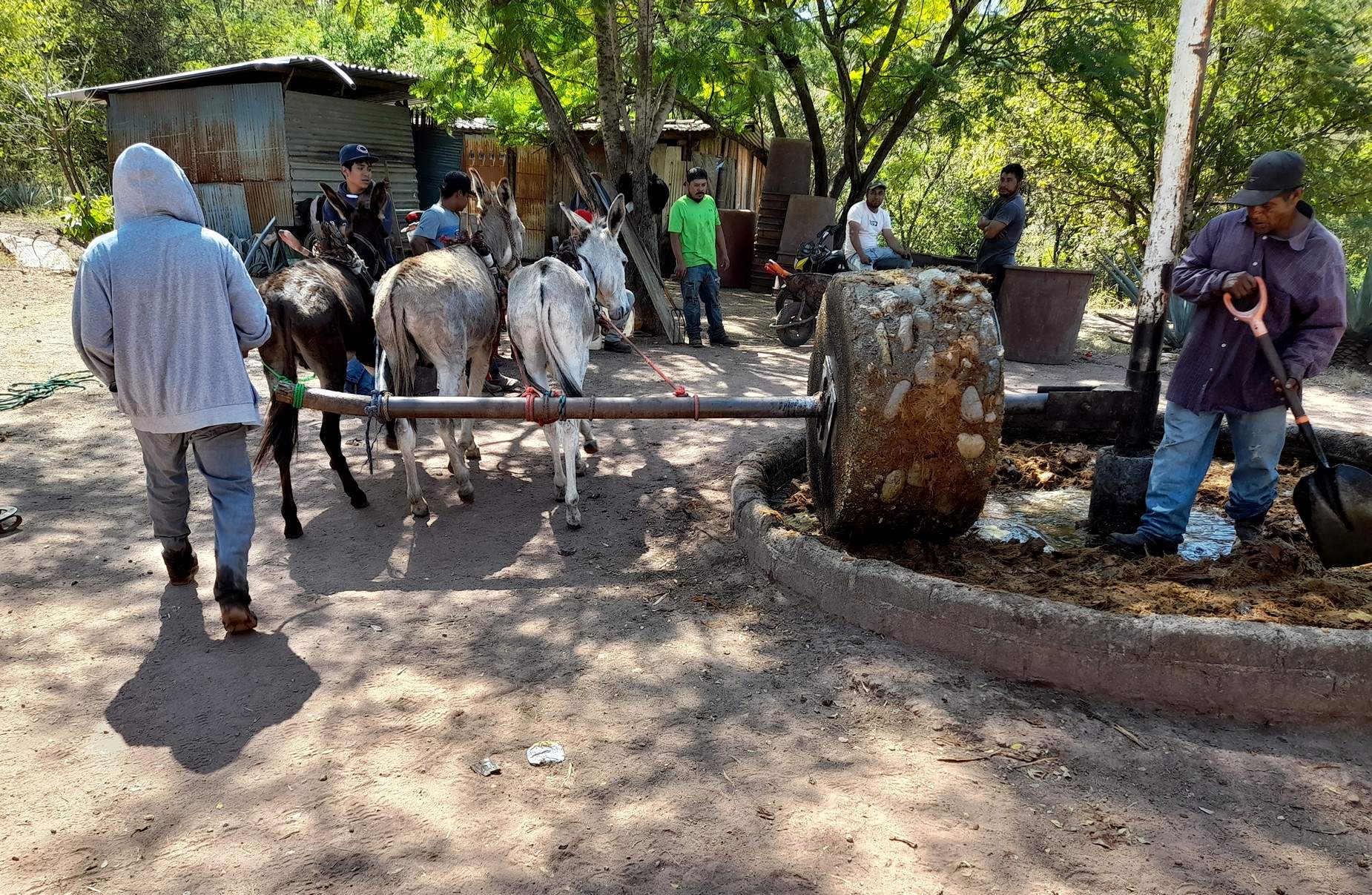
Crushing the baked, sweet agave can be accomplished using a variety of methods. If done traditionally (for producing artesanal mezcal), a beast of burden drags a wheel around a shallow enclosure. The animal need not be dedicated to this type of work, it could be a horse also used for riding, of a team of oxen also used for plowing, and one or more mules used for riding, or carrying agave piñas or firewood from the field. Most animals are multi-purpose to the extent required by the mezcal operation. I know of one American distiller who used to drive his car over the baked agave in order to crush it, admittedly hardly traditional, but nevertheless it did the trick.
Next is fermenting. Any receptacle may be used to hold the now crushed agave. Usually it is a wooden slat vat of 1,000 or so liters. But it can be a plastic container, a concrete enclosure, an animal skin, and even, frequently, cracked clay distilling containers which have been repaired with cement. More sophisticated operations employ stainless steel, but it is certainly not necessary. The point is that almost anything can be, and is, used.
The water which is added can and does come from various sources, depending on the palenquero’s inclination and availability. Usually it is well water, but sometimes mountain spring water or river water based on the season. No yeast is added, but rather air borne yeasts on their own begin to interact with the sweet baked crushed agave which has had water added. Often the agave is not crushed for two or more weeks after being removed from the oven. Mold which forms contributes to the fermentation process.
For the first of the two distillations, the crushed fiber goes into the still along with the now fully fermented liquid. This bagazo, be it from a clay pot, or stainless steel or copper alembic, has served as an insulator so that the piñas do not come in direct contact with the hot rocks. It is commonly also used as compost, as mulch, and to make adobe bricks when mixed with water and earth. Some brands have the bagazo turned into paper for their labels. The water to make the adobe is frequently the waste water produced at the end of the first distillation.
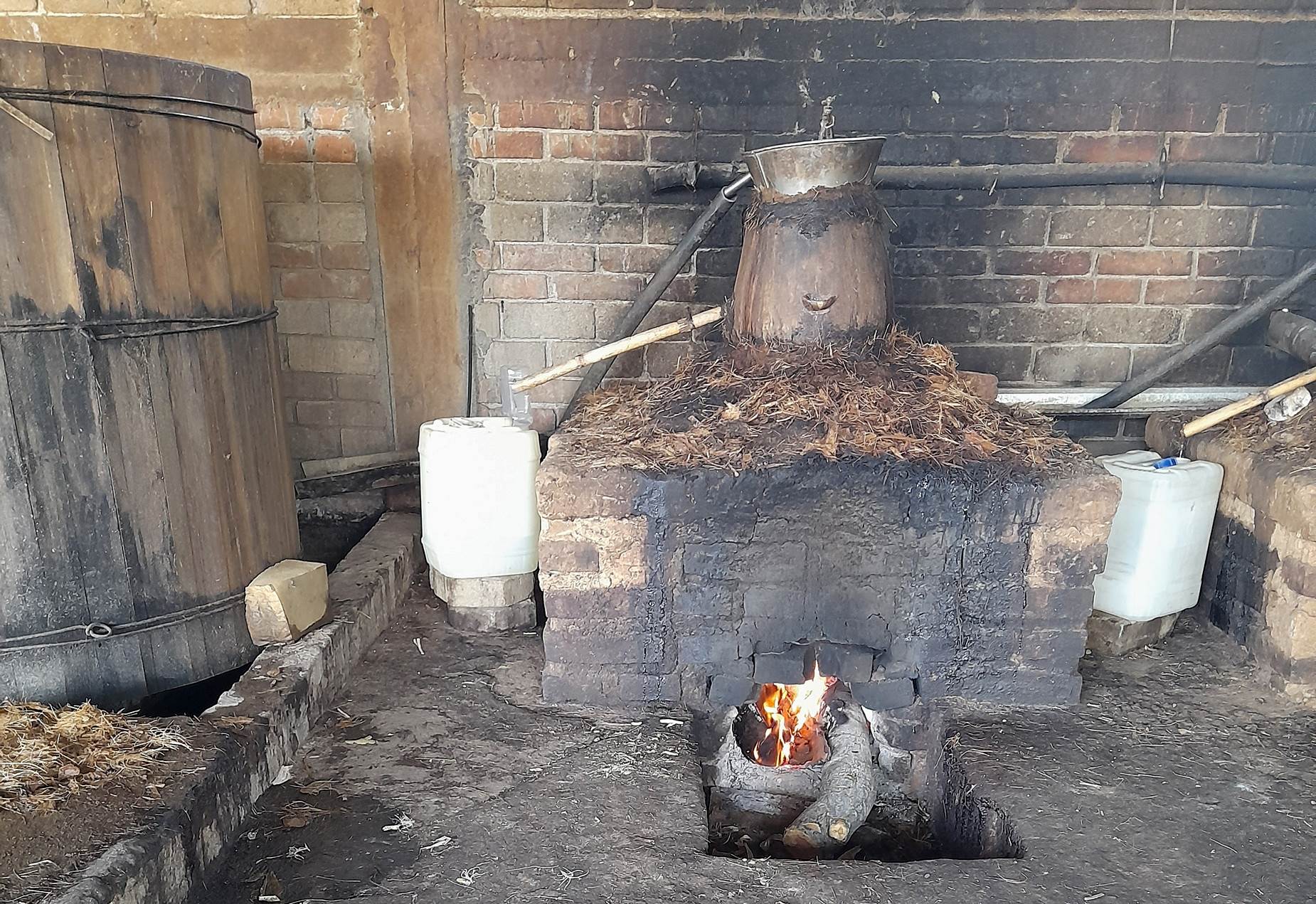
Earlier I mentioned using cracked then repaired clay pots for fermenting. Inevitably the clay pots crack, typically from when the fiber is being pitched out of them, even though the likelihood of this happening is reduced by using a tree branch as a pitch fork. I have often seen a wife attending at the still opening when production is occurring, and removing some of the hot embers, which she then uses to cook. The still opening is often an old dump truck tire rim.
The major aspects of sustainability in the mezcal industry
- Land is in abundance
- Multiple crops are planted between the rows of agave
- Both community members and brand owners, small and large, all work towards a common goal of preserving agave and forests for the future
- Multiple sources of water are used, as available, and water is recycled
- Every step in the process yields new products with multiple uses
- The equipment used comes from different applications
- What the environment yields, finds multiple uses
- Growth in the mezcal industry helps finance village roads, schools, water filtration plants and more
- The mezcal industry produces little or no “waste” as we know it.
Of course the involvement of big businesses and celebrities might adversely impact the industry. But it dramatically increases production, and has the potential to enhance sustainability. The bigger issue is how we continue to promote this type of increase in production, while at the same time maintaining the same high quality of distillate, and employing the same traditional means of production and tools of the trade. That is a fine balancing act.
Related posts on MexConnect
- Mexico’s Mezcal Monkey: collectible ceramic folk art from Oaxaca
- Mexico’s Scorpion Mezcal empowers Oaxaca women
- Oaxaca’s Sierra Mixe: Exploring an ancient cuisine
- The Oaxaca Valley: A week’s adventures in a single day
Alvin Starkman operates Mezcal Educational Excursions of Oaxaca (www.mezcaleducationaltours.com).
Published or Updated on: October 7, 2025