MexConnect
All results for tag “huichol”
Showing 26—41 of 41 results

Sliced Iguana: Travels in Unknown Mexico by Isabella Tree Reviewed by Allan Cogan

Isabella Tree tells about her solitary travels to various parts of Mexico. Is this becoming a sort of literary sub-category - single ladies taking on the world? This book largely consists of a half dozen essays covering specific geographic areas that Ms. Tree visited, including Mexico City, Chiapas and Lake Pátzcuaro. My own personal favorite was "Holy Week," the one on San Miguel de Allende. read more

In a Village Far from Home by Catherine Palmer Finerty Reviewed by Allan Cogan

While living in Guadalajara, Ms. Finerty became acquainted with some Franciscan priests and also with some Huichol Indians who were associated with the Franciscans. Eventually she was invited to visit a Huichol village about a thirty minute flight from Tepic, high in the Sierras in Western Mexico. The only other way to reach this community - Jesús María - was by taking an eight day mule ride. The village wasn't even marked on the map. read more

Huichol Art by Rita Pomade

One of the perks of living at Lakeside is the ubiquitous exposure to the religious art of the Huichol people. The artwork, so vibrant in color and rich in symbolism, effortlessly draws the viewer into ... read more

The Obsidian Butterfly by Erin Cassin

"The Nawatl art is creating archetypes, in the Jungian sense, awakening unconsciously the common roots of the artist and the viewer." Huitzilopotztli Never have I ... read more

Traveling exhibit offers portal into Huichol world by Erin Cassin

The Huichols are one of the four indigenous groups that reside in the region known as the Gran Nayar, located in the southern part of the Sierra Madre Occidental Mountains. The Huichols call themselves... read more

Huichol Voices by Christopher Jordan English

Summer solstice 2003 would be memorable. A local paper mentioned a Huichol vigil to be held near the shoreline of Mexico’s Lake Chapala at a site called Isla de los Patos. The ceremony was to peak on... read more

Symbolic Huichol Art: Journeys of Vision by Judy King

As I walked through the gardens of La Nueva Posada, my eyes were riveted on the young indigenous girl seated on the garden wall. Her vivid yellow skirt and blue top reminded me of our magazine's masthe... read more

The Peoples of Mexico

Mexico is a country of colour, diversity, grand differences in geography, climate and perspective. The same is true of her people. From the mysterious origins and fates of her earliest inhabitants; th... read more

Shamanism and the problem of consciousness by Ronald A. Barnett

Daniel, a Huichol maraka'ame, or shaman-priest momentarily disappeared from the group. A short time later he reappeared. When asked where he had been, he replied in Spanish, "I have been to the moon." read more

Huichol art, a matter of survival: Part Two by Ronald A. Barnett

For years, many people have been predicting the ultimate demise of the Huichol (wii-zaari-taari) as a linguistic and cultural entity. This has not happened. They were first contacted by the Spaniards around 1530. Although many live near main community and religious centres, such as San Andres, Santa Catarina, and San Sebastian, most live in hundreds of small ranchos scattered throughout the Sierras.

read more

Huichol art, a matter of survival: Part One by Ronald A. Barnett

The authenticity of Huichol art on the market today becomes of some importance when called into question by no less an authority on the Indians of Mexico than the famous Mexican historian and anthropologist Fernando Benítez, who once described the popular Huichol yarn paintings as "...a falsification and an industry." read more

Huichol art, a matter of survival: Part Three by Ronald A. Barnett

Huichol art is even more prolific today than it was during the years 1890 to 1898 when Carl Lumholtz, the Norwegian explorer and ethnographer, first visited the Huichol and recorded their symbolic and decorative art in such remarkable detail that we are able to make direct comparisons between Huichol art then and now. The major difference is that today Huichol artisans have a much greater variety of imported and commercial materials with which to work, but many traditional designs and functions have been preserved to the present day. read more

Huichol art, a matter of survival: Part Four by Ronald A. Barnett

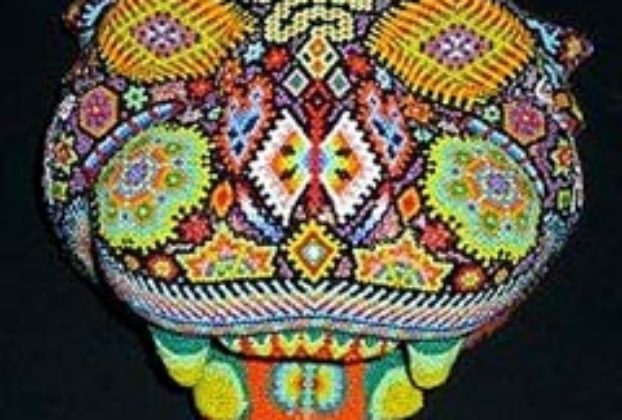
Huichol art has come a long way since Carl Lumholtz first recorded it in the late 19th century It is moving from a strictly religious function to a commercialized folk art. Some items of Huichol art are definitely non-traditional, such as beaded eggs intended for Christmas decorations; others, such as masks of the sun and moon, are borderline traditional. Beaded Jaguar heads are an important symbol in Mesoamerican religion and by no means confined to the Huichol. The bead and yarn paintings are becoming more and more complex, with some risk of becoming more decorative than symbolic or religious. read more

The Huichol: personal reminiscences by Ronald A. Barnett

I began to discover that certain vested interests involving the Huichol did not welcome outsiders. There was almost a political rivalry among various individuals and groups who regarded the Huichol as their own private preserve. This sense of proprietary rights by over the Huichol was confirmed later when I went to Mexico City. Back then there was intense rivalry among people working with the Huichol., too. read more

The Huichol: more personal reminiscences by Ronald A. Barnett

The Fiesta de las Plantas Medicinales is held every year in a different pueblo in Mexico. This three day event features workshops given by curanderos (native healers), herbalists, and other native specialists in various traditional practices and beliefs involving alternative or traditional medicine. I had read in the Fiesta brochure that there was to be a workshop on Traditional Huichol Medicine conducted by a genuine mara'akame (shaman-priest) from the remote sierras. read more
Showing 26—41 of 41 results