The Mexican Revolution - consolidation (1920–40) part 2
His land reform policy reflected the same make-haste-slowly mentality. In his four years of power Obregón distributed three million acres among 624 villages -- hardly a staggering amount but still sev...
read more
The Mexican Revolution - consolidation (1920–40) part 1
Of the major figures in the 1910-20 phase of the Mexican Revolution, only Alvaro Obregón and Pancho Villa remained. In a strange twist of fate, the counterrevolutionaries --Porfirio Díaz and Victoria...
read more
Mexico's marxist guru: Vicente Lombardo Toledano (1894–1968)
It is no more possible to discuss Marxism in Mexico without referring to Vicente Lombardo Toledano than it is to reminisce about Abbott without mentioning Costello. A teacher, writer, union leader and ...
read more
Melchor Ocampo (1814–1861)
Among critics of the Roman Catholic Church in a country where a vast majority of the citizens are nominal Catholics, the charges most frequently heard are those of worldliness and hypocrisy. Anticleric...
read more
Nuño de Guzmán: the Himmler of New Spain (14??–1550)
In 1984, his epic indictment of Stalinism, George Orwell writes that totalitarian man exercises power over others by making them suffer. Arthur Koestler, another great analyst and foe of Soviet communi...
read more
Aztec Hamlet: the tragedy of Moctezuma 2
In history, there are innumerable cases of dynasties toppling because of the weakness of incumbents. The incompetence of do-nothing rulers had much to do with the fall of the late Roman Empire. In Fran...
read more
Miguel Hidalgo: the Father who fathered a country (1753–1811)
Miguel Hidalgo y Costilla had the unique distinction of being a father in three senses of the word: a priestly father in the Roman Catholic Church, a biological father who produced illegitimate childre...
read more
Agustin Yañez: the engaged man (1904–1980)
This title has nothing to do with the state of affairs that precedes matrimony. It is intended in the sense of what the French call an homme engagé, literally, a man engaged in a cause or in so...
read more
Jeronimo de Aguilar: the marooned priest who speeded the conquest
This is a story that would have been laughed out of a Hollywood studio had it ever been submitted as script material: that a leading figure in the Spanish Conquest of Mexico was a shipwrecked priest wh...
read more
The Mexican Revolution: a nation in flux - part 2
Villa broke jail on Christmas Eve and was in El Paso when Huerta engineered the coup that overthrew Madero. In February 1913 Huerta staged a fake 10-day artillery duel with a fake rival, Felix Díaz, n...
read more
The first and the best: Viceroy Antonio de Mendoza
(Viceroy: 1530 - 1550)
The transition from military to civilian rule is not always an easy one. High ranking officers become entrenched in top positions of government and -- as the 1989 fall of th...
read more
The Mexican Revolution: a nation in flux - part 1 (1910-20)
Mexico in September 1910 could be compared to a shiny apple whose glossy skin conceals a putrifying interior. But the corruption underneath was still a secret to the rest of the world. Porfirio Díaz, ...
read more
Nezahualcoyotl: Texcoco's philosopher king (1403–1473)
In the Mesoamerican civilizations that preceded the Spanish Conquest, intellectuals usually derived from the priestly caste rather than from the ranks of warriors and statesmen.
But there was one exce...
read more
Maximilian and Carlota: the "Archdupe" and his tragic lady (1832-1867)
In any political struggle, the spectator's first instinct is to look for a hero and a villain. But you don't always encounter a good guy-bad guy matchup. Though the Soviet Union was our ally in the war...
read more
Zapata and the intellectuals
It is hardly coincidence that the Chiapas rebels under Subcomandante Marcos call themselves Zapatistas and not Villistas or Carrancistas or Obregonistas or even Maderistas -- to name other illustrious ...
read more
Josefa Ortiz de Domínguez: a politically correct "corrector" (1768–1829)
The term " corregidor" is normally associated with an island in the Philippines that witnessed one of the most dramatic and tragic episodes of the Second World War -- when a starving, outgunned, ...
read more
Rebel without a pause: the tempestuous life of Diego Rivera
In art as in life, Diego Rivera was a man constantly in rebellion. At 16, he left the prestigious San Carlos Academy in Mexico City in protest against the academy's emphasis on representational art. He...
read more
Mr. Clean: the phenomenon of Lázaro Cárdenas (1895–1970)
If Diogenes, wielding his famous lamp, ever came into a gallery of Mexican presidents, he wouldn't come away completely empty-handed. In his quest for an honest man, he would snare at least two for his...
read more
Vasco de Quiroga: notes on a practical Utopian (1470–1565)
The term "Utopia" generally has the connotation of a society that is hopelessly visionary and impractical. This is because most of these societies -- Plato's Republic, St. Augustine's City of God and S...
read more
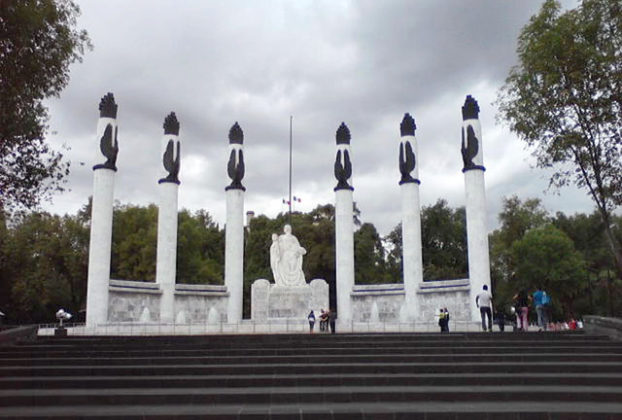
Mexico's Niños Heroes ("heroic children"): reality or myth...
On March 5, 1947 President Harry S. Truman was on the next to last day of a three-day whirlwind visit to Mexico. Departing from his prepared agenda, he announced that he wanted to make a stop at Mexico...
read more
Affirmative action and Hernán Cortés (1485–1547)
Affirmative action can be defined as a process in which members of a certain ethnicity are compensated for the discrimination and second-class citizen status that their ancestors have endured in the pa...
read more
The Temascal: Traditional Sweat Bath
The medicine lodge or sweat bath dates from a very early period in the history of the Americas and, in some parts, continues to the present day. In Canada. Indians from the Atlantic coast to British C...
read more
Did you know? Many common garden flowers originated in Mexico.
Many common garden flowers were developed from samples collected in Mexico by a German botanist financed by Britain's Horticultural Society.
Karl Theodor Hartweg (1812-1871) came from a long line of g...
read more
Immigrant cooking in Mexico: The Afromestizos of Veracruz
This month we'll continue to take a look at the cooking of the immigrants who contributed to the modern Mexican culinary repertoire. Unlike other groups discussed previously — including the Mennonite...
read more
Did you know? Mexico has 36 Magic Towns.
One of the Mexican Tourism Secretariat's flagship programs in recent years has been its Magic Towns designation. This is a program after my own heart, and one that was long overdue when it was finally ...
read more