MexConnect
All results for tag “history”
Showing 376—400 of 416 results

History of Oaxaca: The Pre-hispanic Era Maria Diaz

History of Oaxaca Part 1 - Pre-hispanic Era By Maria Diaz Her Bio Her email: maria@oaxacalive.com In three installments we will present a history of Oaxaca, its pe... read more

Mexico's Voltaire: Jose Joaquin Fernandez de Lizardi (1776-1827) Jim Tuck

Because of the many fables he wrote, there are those who may wish to compare José Joaquin Fernández de Lizardi to La Fontaine. Such a comparison fails to do justice to both writers. Apart from the Co... read more

'Bloody Guzman' Shep Lenchek

Sealed off by mountains to both the East and West, and arid, desert-like land to the North, Mexico’s central altoplano, for eons was home to Nahua, Otomi, Huichol, Cora, Tepehua and Coyutec Indi... read more

Black gold, fool's gold: The oiling of Mexico's petroleum crisis (1938-1988) Jim Tuck

Lázaro Cárdenas, the most left-wing president in Mexican history, became an international bogey man but a national hero by expropriating the foreign oil companies in 1938. Though even such political ... read more

High hopes, baffling uncertainty: Mexico nears the millennium Jim Tuck

The election that brought Miguel de la Madrid's successor to power was clearly fraudulent. On July 6, 1988, when the first results began to arrive at the interior ministry's office on Avenida Bucareli,... read more

The Mexican Red Cross, it's different Shep Lenchek

The Cruz Roja Mexicana functions 24 hours a day, 365 days a year. Like the American and Canadian Red Cross, it assists at disasters, but additionally acts as an Emergency Medical Service. By Mexican la... read more

Mexico's Lincoln: The ecstasy and agony of Benito Juarez Jim Tuck

Since it is the near unanimous verdict of authorities on American history that Abraham Lincoln was our greatest president, it has become a facile formula among historians of other nations to describe t... read more

La Malinche, unrecognized heroine Shep Lenchek

It is time that women discover the Aztec Indian woman called Doña Marina by the Spaniards and La Malinche by her fellow Indians and demand recognition of her as a true heroine. She certainly had as gr... read more

The Orange Tree Reviewed by Allan Cogan

orange tree
Here's Fuentes at it again, publishing short stories and novellas under a single title and trying to interlink them into a cohesive whole as he tried to do in The Crystal Frontier. The connection here is the orange tree, the symbol of Spain. read more

Pancho Villa 1878-1923

Mexconnect writers explore the many faces of Francisco "Pancho" Villa, a key figure in the Mexican Revolution. read more

Octavio Paz: Nobel winner and noble man (1914-1998) Jim Tuck

1998 witnessed the passing of such diverse figures as Frank Sinatra, legendary boxer Archie Moore, two-term Florida Governor Lawton Chiles, cowboy star and entrepreneur Gene Autry, and Clayton ("Peg Le... read more

The Reader's Companion to Mexico Reviewed by Allan Cogan

This is an odd volume. I originally bought it because it advertises itself as "a gathering of some of the best travel writing ever" about Mexico. However, you quickly find as you dip into it that not all the articles are about travel. Also, very few of them have been written in recent times. Indeed, a couple were written about 100 years ago. However, that's not a criticism. read more

Rebel, internationalist, establishmentarian: Carlos Fuentes Jim Tuck

Carlos Fuentes was an internationalist from birth. Though one of Mexico's best-known citizens, he was born on November 11, 1928, in Panama, where his father represented the Mexican government. Mexico p... read more

Mysteries of the Fifth Sun: the Aztec Calendar Dale Hoyt Palfrey

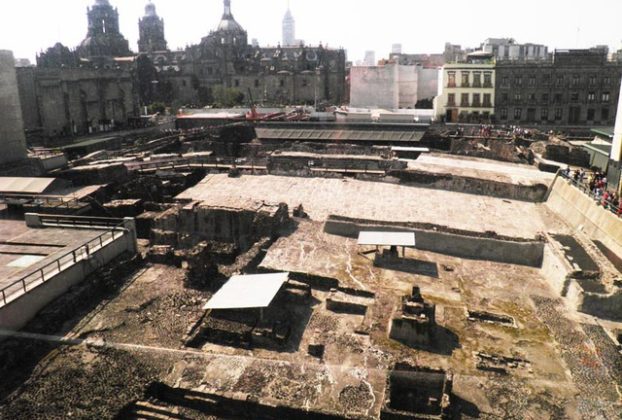
Tenochtitlán, the great island city, capital of the Mexica empire, lies cloaked in darkness. An eerie silence pervades the vast ceremonial center — the Teocalli or Templo Mayor — spreading out over Moctezuma's splendid palace, with its botanical gardens and well-stocked zoo, across the market places, canals, aqueducts, and within each of the humble abodes in the residential wards. For five full days, activity in the normally bustling metropolis has ceased. read more

Aztec Autumn Reviewed by Allan Cogan

Readers of these reviews may remember that I was a big fan of Jenning’s previous work, Aztec. I gave it my highest accolade – five stars. And here comes the sequel, which is almost as good. The action in this one takes place 12 years after all the goings on in Aztec and concerns the adventures of 18 year old Tenamixtli, the son of Mixtli, the hero of the former novel. Indeed, in the first chapter, Tenamixtli witnesses an execution, a burning at the stake publicly carried out by Spanish troops. Later, he discovers that the executed man was his father. How’s that for getting a story started? As you can imagine, revenge plays a big part in the plot. read more

The Maya Civilization: Historical Conflict with the Spaniards Luis Dumois

The Maya Civilization Historical Conflict Part 2   (To Part 1) "Just because of the crazy times, because of the crazy priests, is it that sadness overtook us, that 'Christianity' o... read more

Guadalupe Victoria: Mexico's unknown first president Jim Tuck

History has rarely furnished a more striking example of high-profile-low-profile than that of the first presidents of the United States and Mexico. George Washington was and is the quintessential house... read more

Mexico's irresistible bakeries and breads: Las panaderias Karen Hursh Graber

Como pan caliente - "like hot bread"- is the expression used in Mexico to indicate something that is popular, best selling, or in demand. And indeed, going for hot bread is one of the daily culinary ro... read more

The Maya civilization: Historical conflict Luis Dumois

There is no truth in the words of foreigners. Chilam Balam of Chumayel The news arrives every day: accusations of menacing maneuvers by the Mexican army in Chiapas, proclamations an... read more

The economy of New Spain: Mexico's Colonial era Dale Hoyt Palfrey

The chief function of the colonies in the eyes of the Spanish Hapsburg kings — who ruled until 1700 — was to make Spain stronger, richer and more self-sufficient. Raw materials brought home from th... read more

Religion and society in New Spain: Mexico's Colonial era Dale Hoyt Palfrey

No sooner had the Spanish conquistadores vanquished the Aztec Empire militarily, than the spiritual conquest of Indian Mexico began. The Spaniards were devoutly Roman Catholic. It should be r... read more

The settlement of New Spain: Mexico's Colonial era Dale Hoyt Palfrey

The fall of the Aztec Empire and capture of its ruler Cuauhtémoc (1521), left Spanish conquistador Hernán Cortés in charge of a vast and largely unfamiliar land. By 1522 his sovereign, Car... read more

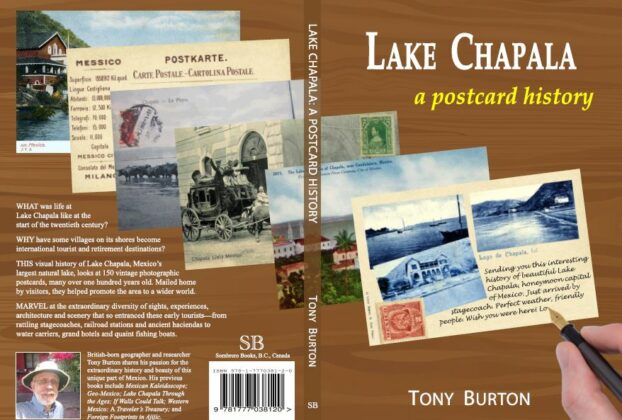
Dr. Atl and the revolution in Mexico's art Tony Burton

At the start of the Mexican Revolution (1910) painting in Mexico had reached an all-time low. The then President, Porfirio Diaz had been in power for more than 30 years and in the words of famous Ameri... read more

Diego, Frida and the Mexican School Joe Cummings

Awarded June, 1999 Mexico City in the 1920s stood on the threshold of a new era. Although the country had won its independence from Spain in 1821, it became o... read more
Showing 376—400 of 416 results
All Tags