Did you know? Mexico has over thirty UNESCO-designated biosphere reserves
A surprising percentage of Mexico's land area is protected in one form or another. A very large number of sites of archaeological or historical importance are managed by the National Institute of Anthr...
read more
Monarch butterflies in Mexico
Early in 1980, exploring various off the beaten track areas of Mexico looking for potential geography fieldwork sites, one fateful Saturday morning found me standing in the main plaza of the small Mich...
read more
Did you know? Mexico's largest bird is the American White Pelican
The American White Pelican is Mexico's largest bird, while its relative the Brown Pelican is one of the most fun to watch.
White Pelicans on Lake Chapala;
photo: John Mitchell, Earth Images Foundat...
read more
Did You Know? Mexico is home to oldest indigenous American domesticated dog breed.
When someone mentions "dogs" and "Mexico" in the same sentence, most people think immediately of the cute Chihuahua, small in proportions and large in personality but commonly dismissed by lovers of larger dogs as a small and unimportant "toy" breed.
read more
Following The Monarch Butterfly To The Highlands Of Mexico Monarch Butterflies Tour
Following the Monarch Butterfly to the Highlands of Mexico
E. Pluribus Gehrlein.
The other side of the coin
First published in the Adirondack Mountain Sun, Volume 10, Number 19, Februa...
read more
Did You Know? Some national symbols in Mexico are not what they seem
This month, Mexico celebrates her birthday, the anniversary of her independence from Spain. On the evening of September 15, the annual El Grito ceremony is held in town plazas all across the cou...
read more
White pelicans on Lake Chapala
Granddaughter Kim couldn't resist. Our slender, pert redhead scampered along the flatland toward the water. Thousands of white pelicans immediately got the message. After a second or three of awkward, ...
read more
Where The Butterflies Are
Our two friends from AmSoc told Mary and me about going to see the Monarch butterflies. Every year the Monarchs migrate from Canada and the US to their winter home in central Mexico. As they migrate, s...
read more
Migration Minded
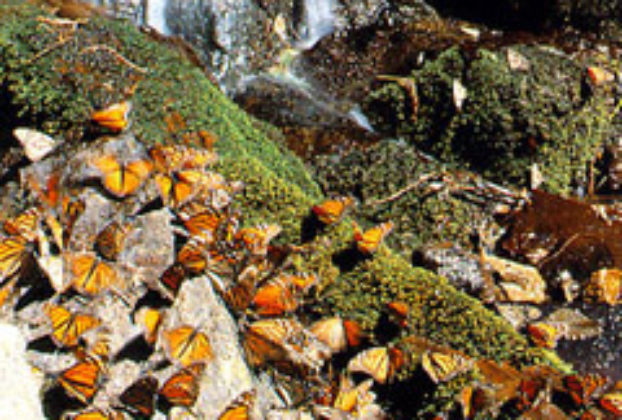
Mexico experiences one of nature's loveliest gifts each winter when billions of Monarch butterflies descend on the warm forests of the country's central highlands.
The Monarch is known for its lo...
read more
The foundational bull ranches
It has always seemed appropriate to me that the Spanish Ministry of Agriculture, in their monograph Geografia Espanola del Toro de Lidia, uses the valleys of the major rivers of Spain to structure thei...
read more
The Majestic Monarch Butterfly
The amazing phenomena of the Monarch butterfly migration is with us again. At the end of summer hundreds of millions of monarchs fly an incredible average of 1,800 miles from the United States and Cana...
read more
Arteplumaria - the Mexican art of feather painting
Did you know that one of the highest, most elegant and sumptuous arts of pre-Conquest Mexico was arteplumaria, the art of feather painting? Used to decorate headdresses, standards, staffs, lances,...
read more
The Baja Animal Rescue Team
Pets are a billion-dollar industry in the United States, but even for the U.S., homeless cats and dogs are a major problem. There is civic funding to established programs to help control the situation,...
read more
Lake Chapala: Can Mexico's largest lake be saved?
Lake Chapala, Mexico's largest natural lake, is dying. The lake right now plays a vital role in a gigantic ecosystem, the River Lerma-Lake Chapala drainage basin, which includes more than 8 million peo...
read more
Lake Chapala: 2000 follow-up to saving Mexico's largest lake
This article is Part 2 of Tony Burton's series:
"Can Mexico's Largest Lake be Saved?" .
Part 1: May, 1997 - Can Mexico's Largest Lake be Saved?
Part 3: M...
read more
Lake Chapala: 2001 follow-up to saving Mexico's largest lake
This article is Part 3 of Tony Burton's series:
"Can Mexico's Largest Lake be Saved?" .
Part 1: May, 1997 - Can Mexico's Largest Lake be Saved?
Part 2: M...
read more
Did you know? Sheep and environmental damage in Mexico
Belive it or not, the introduction of sheep to Mexico had serious environmental consequences.
After the Conquest, Spanish settlers introduced numerous Old World species into the New World. The mos...
read more
Did you know? Mexico's vultures have very different eating habits.
Vultures (zopilotes in Spanish) are among the most conspicuous birds in many parts of Mexico. Commonly misidentified as eagles, these blackish scavengers can be seen almost anywhere, often in large flo...
read more
Fish and shellfish names: English and Spanish translations
SEAFOOD & FISH
English
Spanish
Anchovy
=
Anchoa
Sea Bass
=
Mojarra
Carp
...
read more
Did you know? The first scientific account of Lake Chapala comes from 1839
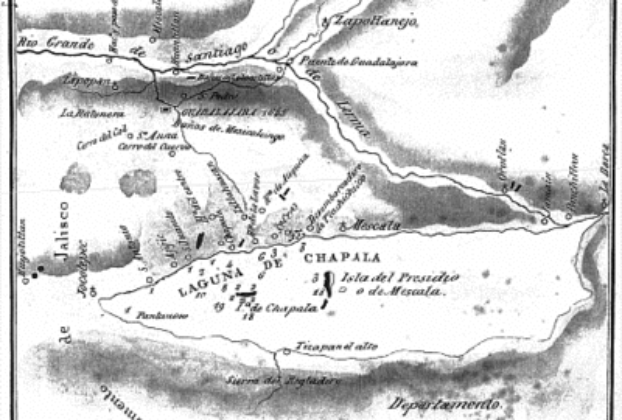
The first detailed scientific account of Lake Chapala was written by Henri Guillaume Galeotti. It was based on a visit to Chapala in February-March 1837. The article was published first in French in 18...
read more