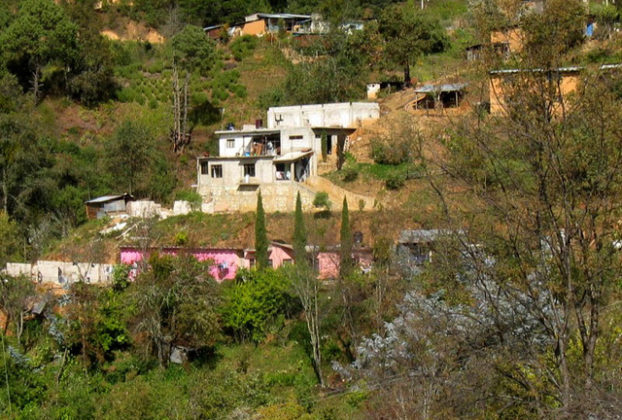
Did you know? An enchanted lake in Veracruz rises every dry season, but falls again during the wet season
Peculiar, but true. There are several lakes named Laguna Encantada (Enchanted Lake) in Mexico, but this one is near Catemaco in the Tuxtlas region of the state of Veracruz. Catemaco is famous for its w...
read more
Did you know? Small village in Mexico wins UN Development Prize
Every two years, the United Nations Development Programme (UNDP) awards the Equator prize (worth 30,000 dollars) to communities that have shown "outstanding achievement in the reduction of poverty thro...
read more
Lake Chapala: a review of "The Lerma-Lake Chapala watershed: evaluation and management"
Edited by Anne M. Hansen and Manfred van Afferden
(New York: Kluwer Academic / Plenum Publishers, 2001)
This article is Part 5 of Tony Burton's series:
"Can Mexico's Largest...
read more
Miraculous Air: A Journey of a Thousand Miles through Baja California, the Other Mexico by C. M. Mayo
Most of us think of the Baja Peninsula as a vast, sprawling, empty, underpopulated space on the Pacific Coast with hundreds of miles of desolate beaches. To a great extent, that's what it is. What Ms. Mayo gives us in Miraculous Air is a beautifully researched account of the history, geography, ecology, oceanography, the folklore, the wildlife and the incredible fishing in this vast area. We read of cave paintings of people who lived in the area some 10,800 years ago. And along the way, we meet a few quite interesting and memorable people.
read more
Four Wings and a Prayer: Caught in the Mystery of the Monarch Butterfly by Sue Halpern
Monarchs are genuinely fascinating creatures and here's a book that really does justice to their story. The travel accomplished by Monarchs is simply mind-boggling. They fly forty miles a day on average but sometimes - depending on winds and weather - they can manage up to 200 miles between dawn and dusk. Those born to the East of the Rockies usually go to Mexico. Those born to the West mostly go to California. All flying is done in daylight - never at night.
read more
Lloyd Mexico Economic Report October 2002
Table of Contents
STATE OF THE NATION REPORT
GOOD GROWTH PROSPECTS
HIGHLIGHTS OF RECENT PROGRESS
RE...
read more
Lake Chapala: Part 4 - 2002 follow-up to saving Mexico's largest lake
Fish, farmland or bungee-jump?
This article is Part 4 of Tony Burton's series:
"Can Mexico's Largest Lake be Saved?" .
Part 1: May, 1997 - Can Mexico's Largest ...
read more
Endangered Mexico: An Environment on the Edge by Joel Simon
There's no good news in Joel Simon's book. It's a catalog of the awful things that have happened in Mexico since the time of the Conquest.
read more
Lloyd Mexico Economic Report - April 2001
Table of Contents
PRODUCTIVITY ON THE RISE
BOEING TO OPEN MEXICO CITY OFFICE
RECORD FOREIGN RESERVES
...
read more
Lake Chapala: 2001 follow-up to saving Mexico's largest lake
This article is Part 3 of Tony Burton's series:
"Can Mexico's Largest Lake be Saved?" .
Part 1: May, 1997 - Can Mexico's Largest Lake be Saved?
Part 2: M...
read more
Lloyd Mexico Economic Report - September 2000
Table of Contents
CONSUMERS SPEND, SPEND, SPEND...
MONETARY REGULATION BONDS
TEQUILA INDUSTRY STUMBLES
...
read more
Mexico's water woes
Dr. Leopoldo Rodarte Ramón, general director of the Federal District Water Commission, has a tough job. He is responsible for supplying an ever-growing population with water, draining thousands of ton...
read more
Lake Chapala: 2000 follow-up to saving Mexico's largest lake
This article is Part 2 of Tony Burton's series:
"Can Mexico's Largest Lake be Saved?" .
Part 1: May, 1997 - Can Mexico's Largest Lake be Saved?
Part 3: M...
read more
Lake Chapala: Can Mexico's largest lake be saved?
Lake Chapala, Mexico's largest natural lake, is dying. The lake right now plays a vital role in a gigantic ecosystem, the River Lerma-Lake Chapala drainage basin, which includes more than 8 million peo...
read more