
According to collecting experts, Mexican lobby cards of U.S. films are rarer than U.S. lobby cards of the same since fewer of them were printed. They wallow in exploitation, indulging in as much sex and violence as their respective eras legally allowed. Vampires are vampires. Aliens are aliens. Babes are babes. Criminals are criminals. Abominable Snowmen are Abominable Snowmen. Krakatoa is still East of Java (even though it's west) and will remain that way for all eternity.
read more
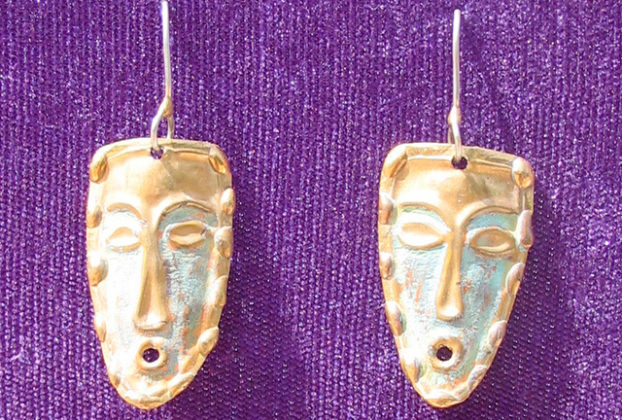
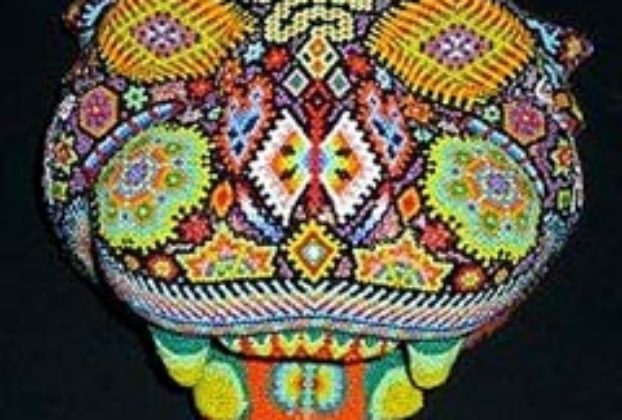
Huichol art has come a long way since Carl Lumholtz first recorded it in the late 19th century It is moving from a strictly religious function to a commercialized folk art. Some items of Huichol art are definitely non-traditional, such as beaded eggs intended for Christmas decorations; others, such as masks of the sun and moon, are borderline traditional. Beaded Jaguar heads are an important symbol in Mesoamerican religion and by no means confined to the Huichol. The bead and yarn paintings are becoming more and more complex, with some risk of becoming more decorative than symbolic or religious.
read more
Huichol art is even more prolific today than it was during the years 1890 to 1898 when Carl Lumholtz, the Norwegian explorer and ethnographer, first visited the Huichol and recorded their symbolic and decorative art in such remarkable detail that we are able to make direct comparisons between Huichol art then and now. The major difference is that today Huichol artisans have a much greater variety of imported and commercial materials with which to work, but many traditional designs and functions have been preserved to the present day.
read more
For years, many people have been predicting the ultimate demise of the Huichol (wii-zaari-taari) as a linguistic and cultural entity. This has not happened. They were first contacted by the Spaniards around 1530. Although many live near main community and religious centres, such as San Andres, Santa Catarina, and San Sebastian, most live in hundreds of small ranchos scattered throughout the Sierras.
read more
The authenticity of Huichol art on the market today becomes of some importance when called into question by no less an authority on the Indians of Mexico than the famous Mexican historian and anthropologist Fernando Benítez, who once described the popular Huichol yarn paintings as "...a falsification and an industry."
read more
The center arch of the wall contains the Mexican eagle holding a serpent that showed the end of the Aztecs' migration. Included on the current Mexican flag, the eagle also represents a resurgent Mexico...
read more
Some 30 years ago, a youthful 27-year-old acquired a piece of machinery by chance. Not knowing exactly what to do with it, or how it could somehow become a positive factor in his life, he took a gamble...
read more
Ford Times, the monthly magazine of the Ford Motor Company. John Russell Clift, the author and illustrator, was born in 1925 and at the peak of his career in the 1950s when he wrote this piece, one of the earliest to promote the attractions of the Chapala area as a retirement haven. His thoughtful prose and fine silkscreens paint a vivid picture of what life was like at Lakeside 50 years ago.
read more
Besides being used as a kind of rough paper for records and correspondence, amate was also cut into human or animal forms as part of witchcraft rituals after which it would be buried in front of the pe...
read more
A young couple who became famous artists pioneered the San Miguel de Allende foreign community.
San Miguel de Allende's vibrant art and music scene is deservedly famous. Among the early pioneers respo...
read more
One of the oldest printing presses still in operation anywhere in the world is in Tacámbaro, Michoacán.
Juan Pascoe lives on a remote ex-hacienda outside Tacámbaro, Michoacán. Visitors invited to ...
read more
In the current edition of Guinness, the Mexican responsible for most records is Sergio Rodriguez Villarreal from the northern state of Nuevo León. He specializes in creating giant Christmas figures an...
read more
Muros, which means "walls" in Spanish, opened to the public in May of 2004. It is the only museum in Cuernavaca, Morelos originally designed to be a museum. The space is flexible with movable lighting,...
read more