Hola! Welcome to MexConnect, the world’s largest content website about Mexico.
You have reached this page through an out-dated link.
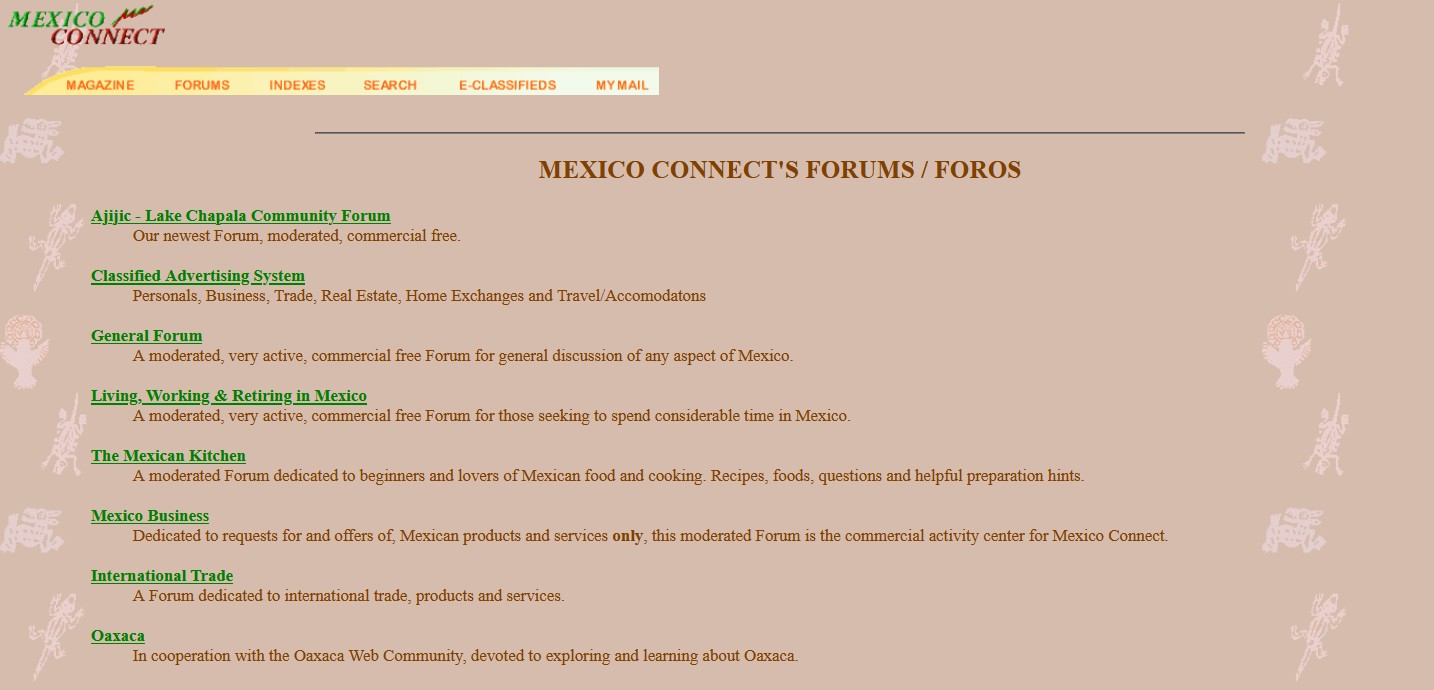
The world famous MexConnect forums (1996-2019) have been archived and are no longer being updated. To access read-only versions of the entire forums (200,000 posts in 30,000 threads), please try the following link:
The MexConenct forums were among the earliest interactive discussion boards on the web. Under the overall direction of MexConnect founder David McLaughlin, all threads and comments were moderated by a team of Mexico experts (including the incomparable Rolly Brook, Cristina Potters and many others) who helped guide discussions to stay on track (more or less). Our experienced moderators helped ensure that comments on the forum were as polite, inclusive and useful as possible for our many readers.
The rise of mass social media, such as Facebook et al., eventually provided alternative ways to share, discuss and distribute information, even if we old-timers can only lament the almost complete lack of any reliable content moderation or fact-checking.
Here we have archived some of the more interesting, useful, and/or popular posts from our old forums. Please note that information in these threads may no longer be entirely up-to-date. The full list of saved threads is available by clicking here: Forum Archives
As a preview, here are some of the available saved threads:
Posted by Janis on August 12, 1999 Hola a Todos, This is not meant to be a political question, I know this may seem impossible, but I am looking for some factual info. Last evening I saw a documentary by Nettie Wild entitled “A Place Called Chiapas.” Wild is a Canadian filmmaker who spent eight […] beatricemor, Nov 29, 2007, We bought into the El Cerrillo Barrio in San Cristóbal de Las Casas because it was near the indigenous market, the Santo Domingo convent and the town´s historic center. A wonderful and ancient barrio if rather poor and ratty in a charming way. Someone I know was telling a tale about […] Posted by charlie g. on April 11, 1999 On the road again – Oaxaca to Guad – The good, the bad and the ugly After getting set up to stay in Oaxaca for a while I decided last week to make a quick trip to Guadalajara and Ajijic to pick up some stuff I left […]Who is Subcomandante Marcos

On Posses and Prostitution
Oaxaca to Guadalajara: The good.. the bad.. & the ugly
To access the Home Page of the new MexConnect website, please use this link:
The main sections of MexConnect website are:
- Culture and Arts
- Food and Cuisine
- History and People
- Living, Working and Retiring
- Travel and Destinations
Welcome to MexConnect – please explore our site and enjoy!
Saludos,
Your friends at MexConnect, the world’s largest content website about Mexico.