Hola! Welcome to MexConnect, the world’s largest content website about Mexico.
You have reached this page through an out-dated link.
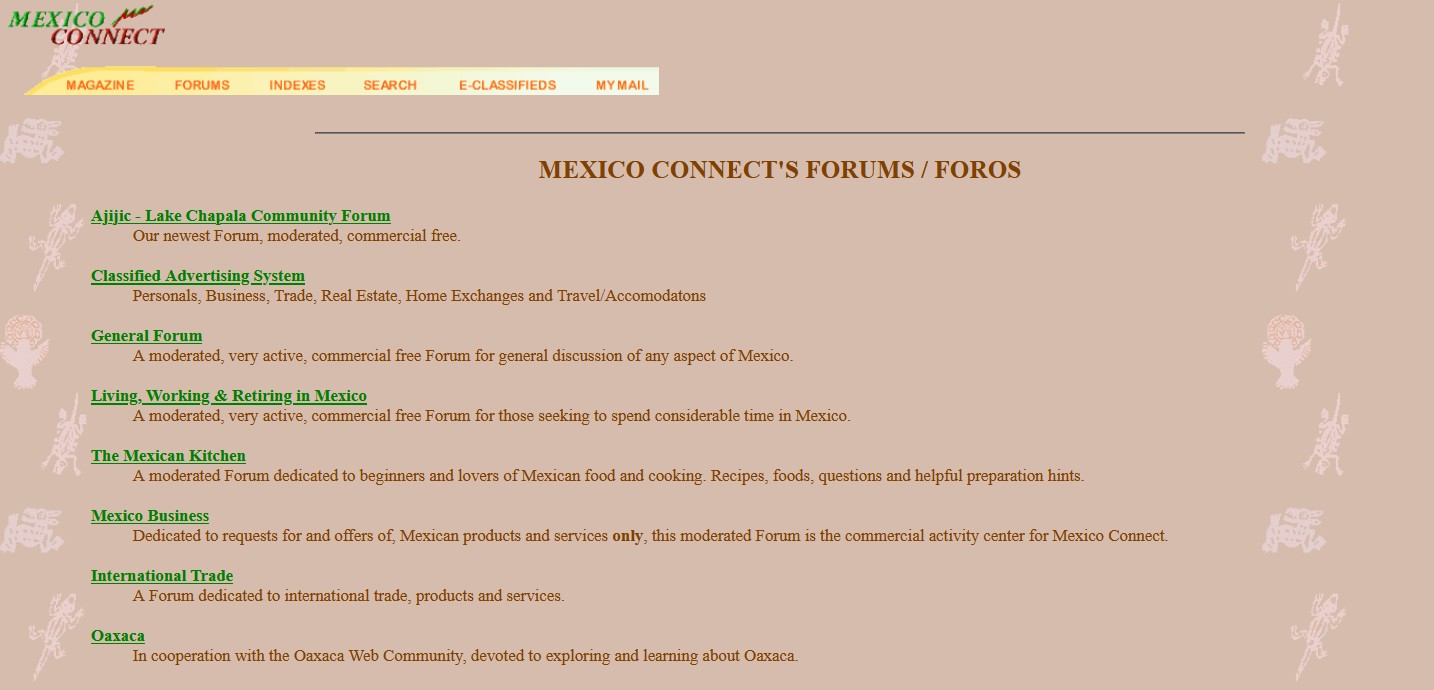
The world famous MexConnect forums (1996-2019) have been archived and are no longer being updated. To access read-only versions of the entire forums (200,000 posts in 30,000 threads), please try the following link:
The MexConenct forums were among the earliest interactive discussion boards on the web. Under the overall direction of MexConnect founder David McLaughlin, all threads and comments were moderated by a team of Mexico experts (including the incomparable Rolly Brook, Cristina Potters and many others) who helped guide discussions to stay on track (more or less). Our experienced moderators helped ensure that comments on the forum were as polite, inclusive and useful as possible for our many readers.
The rise of mass social media, such as Facebook et al., eventually provided alternative ways to share, discuss and distribute information, even if we old-timers can only lament the almost complete lack of any reliable content moderation or fact-checking.
Here we have archived some of the more interesting, useful, and/or popular posts from our old forums. Please note that information in these threads may no longer be entirely up-to-date. The full list of saved threads is available by clicking here: Forum Archives
As a preview, here are some of the available saved threads:
Posted by Thom on January 04, 1997 My wife and I just returned from MONTH in Mexico, the better part of which we spent in Mazatlan. We have been to Mexicoís other Pacific coast resort areas several times, but for some reason, we had never been to Mazatlan. We booked our flight and the first […] Posted by beth elsey on May 23, 1999 We plan to visit Queretero, Guanajuato, San Miguel de Allende and Morelia next week–would like any tips on charming places to stay (moderate range US50-70) and great places to eat. We will be doing the bus tour so places close enough to walk (less than a mile […] Semana Santa in Morelia means a vacation at home for me. For one thing, I don’t want to become a statistic by hitting the open road, and for another, I don’t like crowds. But most importantly, I bask in those times when the help are gone and it’s just me and my Doberboys. By Thursday, […]Mazatlan Trip Report
The colonial cities
Personal Views of Easter in Mexico
To access the Home Page of the new MexConnect website, please use this link:
The main sections of MexConnect website are:
- Culture and Arts
- Food and Cuisine
- History and People
- Living, Working and Retiring
- Travel and Destinations
Welcome to MexConnect – please explore our site and enjoy!
Saludos,
Your friends at MexConnect, the world’s largest content website about Mexico.